
Payouts Methodology
How Payouts Work
A payout is a financial transaction recorded in a two sided ledger:
- Debit: Deducts the specified amount from your Business Balance, ensuring accurate records and monitoring of available funds.
- Credit: Adds to the Wallet User’s available balance, representing funds accessible for transactions and purchases.
Transaction Statuses
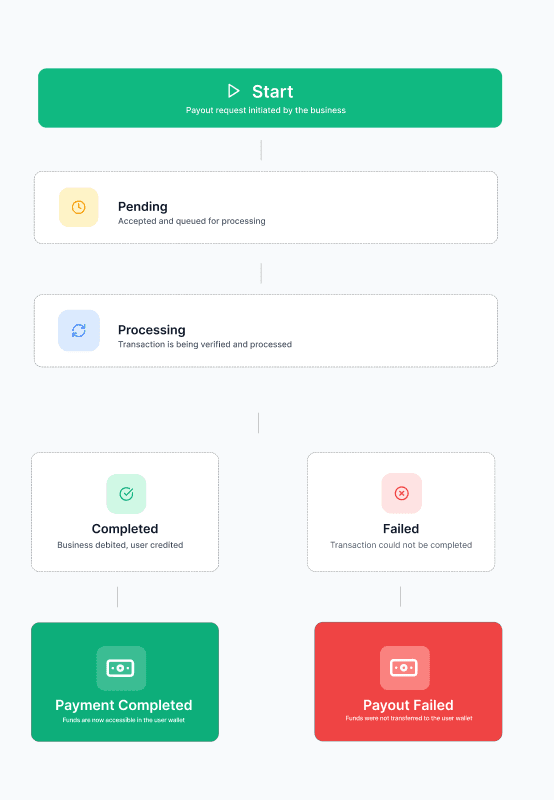
- Pending: The transaction has been accepted and is currently in the queue, awaiting processing.
- Processing: The transaction is undergoing validation, and the posting to the ledger is actively in progress to ensure accurate record keeping.
- Completed: The transaction has successfully concluded, with the business account debited and the user's account credited accordingly.
- Failed: The transaction was unable to complete, resulting in no credit being applied to the user's account.
Every payout is traceable through:
- Payout ID: A unique identifier assigned to each payout transaction, allowing for easy tracking and reference within the financial system. 2.** Reference I**D: A designated reference number or code associated with the payout, which helps specify the purpose or origin of the transaction. This could include invoice numbers, client identifiers, or payment request IDs.
- Ledger Transaction Entries: Detailed records capturing the financial movements involved in the payout process. This includes:
- Business Debit: The amount deducted from the business’s account, reflecting the outgoing funds for the payout.
- User Credit: The corresponding amount credited to the user's account, representing the net funds received by the user as part of the payout.
- Timestamps: Essential chronological markers that document critical stages of the payout process:
- Created: The date and time when the payout was initially generated.
- Processed: The date and time when the payout transaction was executed and entered into the financial system.
- Settled: The date and time when the funds were successfully transferred and made available to the recipient, completing the payout cycle.
This structured approach ensures transparency and accountability throughout the payout process.

Payouts Limits and Compliance
In order to maintain compliance and ensure the safety of all payouts, Vrtx implements a series of strict measures:
- Business Balance Assessments: Comprehensive evaluations are conducted to ensure that business accounts do not experience overdrafts. All payout transactions must be aligned with the available balance to prevent negative account conditions.
- Recipient Eligibility Verification: Vrtx verifies several factors concerning the recipient's wallet, including its operational status and, when necessary, the completion of Know Your Customer (KYC) procedures. This verification ensures that only qualified recipients are eligible to receive funds.
- Regulatory Limitations: To comply with all required regulations, Vrtx enforces specific limits on wallet balances and monthly transaction volumes. These regulatory ceilings are designed to mitigate risks associated with large financial transfers and ensure commitment to financial legislation. 4.** Risk and Compliance Protocols**: The organization employs comprehensive protocols for risk management, including the screening of transactions for suspicious activities and the detection of anomalies. These measures are essential for identifying irregular patterns that could suggest fraudulent behavior.
If a payout is unable to be processed, the user will receive a precise error code accompanied by a recommended action for resolution. This approach ensures clarity and guidance in addressing any issues that may arise during the transaction process.