
Accounts Overview
In Vrtx, every amount you see—whether it is a customer wallet balance, a business pre-fund balance, transaction fees, or card authorization holds—is linked to a clearly defined account within our financial ledger.
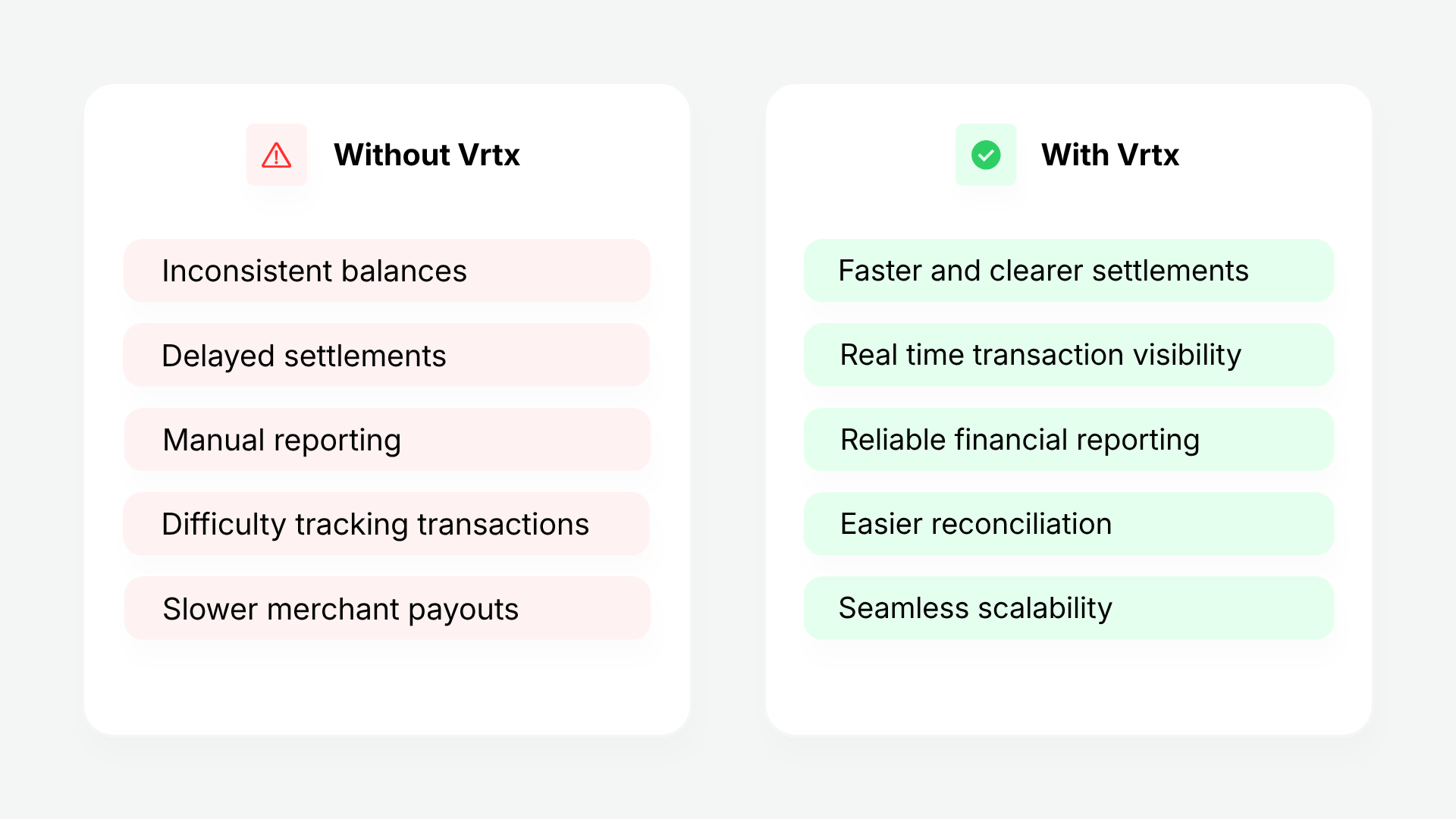
In simple terms, every amount is fully traceable from source to destination. This gives merchants accurate reporting, faster settlements, and real-time visibility into the movement of funds, without discrepancies or unclear balances.
Merchant Outcome
Instant financial clarity that strengthens liquidity management and accelerates business decisions.
Core Principles
Our ledger is built on four foundational principles to guarantee absolute financial accuracy.
No Unexplained Balances
Every financial movement is recorded as a clear ledger entry.
Strict Fund Separation
Platform, business, and customer funds are always kept strictly separate.
Settlement-Ready
Fully aligned with banking and card network settlement flows.
Built for Real Scenarios
Supports spending limits, holds, reversals, refunds, disputes, and fees without affecting statement accuracy.
How It Works
The system is powered by three core components working seamlessly together:
Chart of Accounts
The financial structure that organizes every account within the system.
Ledger Engine
The accounting engine that records every transaction instantly and in an organized manner.
Accounting Cycle
The operational framework that ensures every transaction moves through a clear lifecycle, from initiation to final settlement.
The Journey of a Transaction
Because customer behavior isn't always a straight line, our Accounting Cycle is designed to be a highly flexible and dynamic process. The cycle is simply the sequence of operations that captures a financial event from its very first step to its final entry.
Adapting to Reality
Consider a scenario where a customer makes a regular purchase today, but decides to request a refund tomorrow. Our system seamlessly adapts to these changes in behavior, modifying the financial entries and successfully closing the cycle only after the refund is fully processed.
The Step-by-Step Flow
Initiation
A transaction is triggered by a service (like a payment gateway), sending the details directly to the Ledger Engine.
Validation
The engine immediately checks the incoming data to ensure it is complete and accurate.
Mapping
The system maps the event to the correct accounts within the Chart of Accounts to determine exactly where the money is coming from and going to.
Recording & Closing
Perfect double-entry records are created, balances are updated in real-time, and the cycle is securely closed.