Onboarding
Before a customer can hold a wallet, send money, or spend with a card, they need to be verified. In KSA, that means identity checks, sanctions screening, mobile ownership confirmation, and risk assessment — all mandated by SAMA.
The Vrtx Onboarding Engine handles every step of the compliance journey automatically — from the moment a customer enters their ID to the moment their wallet is live. Your team integrates once via the Vrtx SDK. Everything else runs in the background.
Fully SAMA compliant
The Vrtx onboarding flow is designed and maintained to meet SAMA's regulatory requirements for digital onboarding, KYC, AML, and sanctions screening. Compliance updates are handled at the infrastructure level — not by your team.
What Vrtx handles for you
This is everything that runs automatically when a customer onboards through your product. You collect two fields. Vrtx does the rest.
Sanctions screening
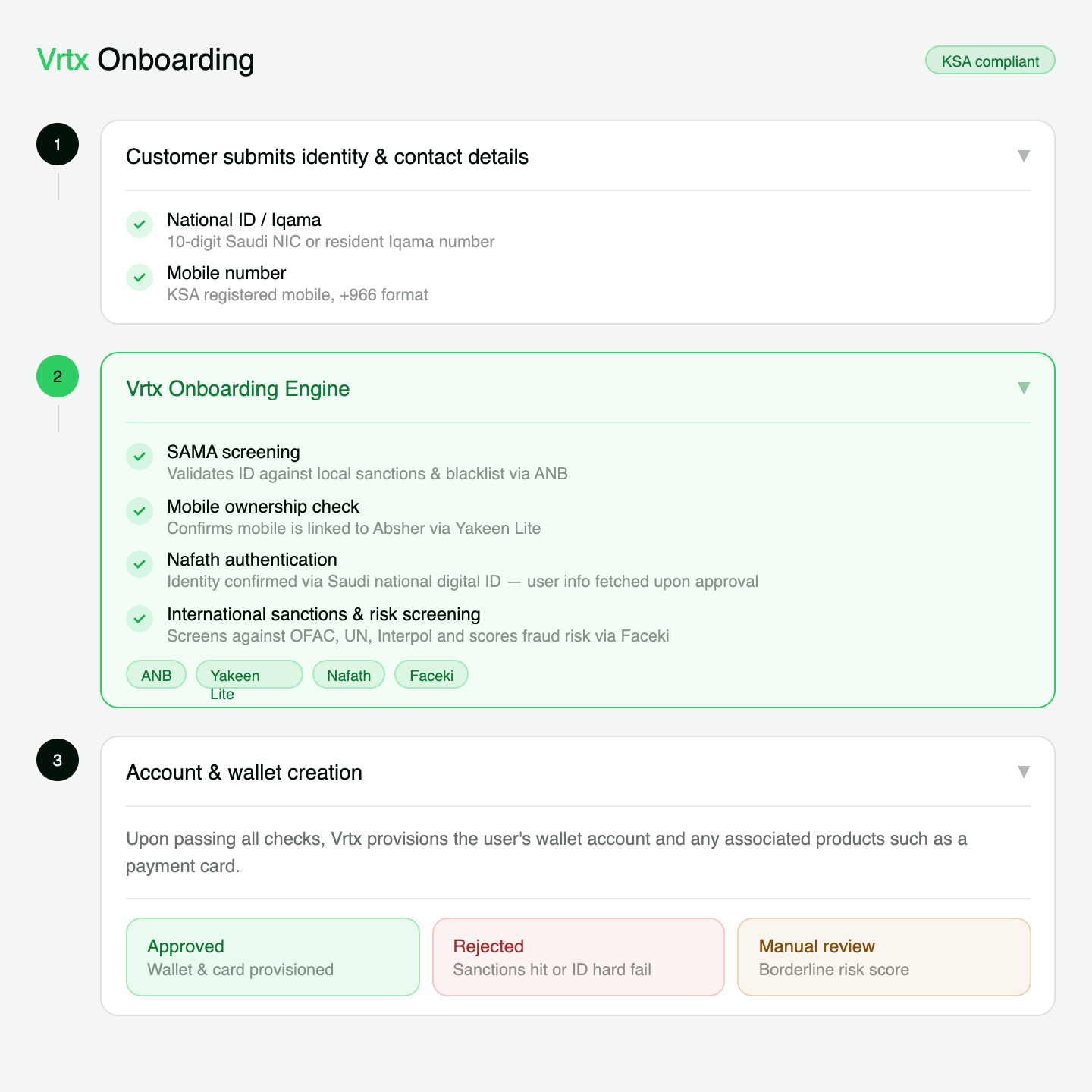
Every customer is checked against the local sanctions and blacklist.
Mobile ownership verification
Confirms the customer's mobile number is genuinely linked to their Absher account via Yakeen Lite, not just self-declared.
Nafath identity authentication
The customer's identity is confirmed through Saudi Arabia's national digital ID system. One tap in the Nafath app. No documents, no manual review.
The onboarding flow
Here's exactly what happens — from first input to wallet creation. Click any step to see what runs underneath.
What you don't have to build
Without an infrastructure partner, your team would need to independently contract and integrate a SAMA-approved sponsor bank, Yakeen Lite for mobile verification, Nafath for biometric authentication, a KYC data provider, a local sanctions screening provider, an international watchlist screening provider, a fraud and risk scoring engine, account tier logic, audit and compliance logging, and exception handling for every failure scenario.
That's 10+ vendor relationships, 10+ technical integrations, and an ongoing compliance maintenance burden — before you've built a single product feature.